
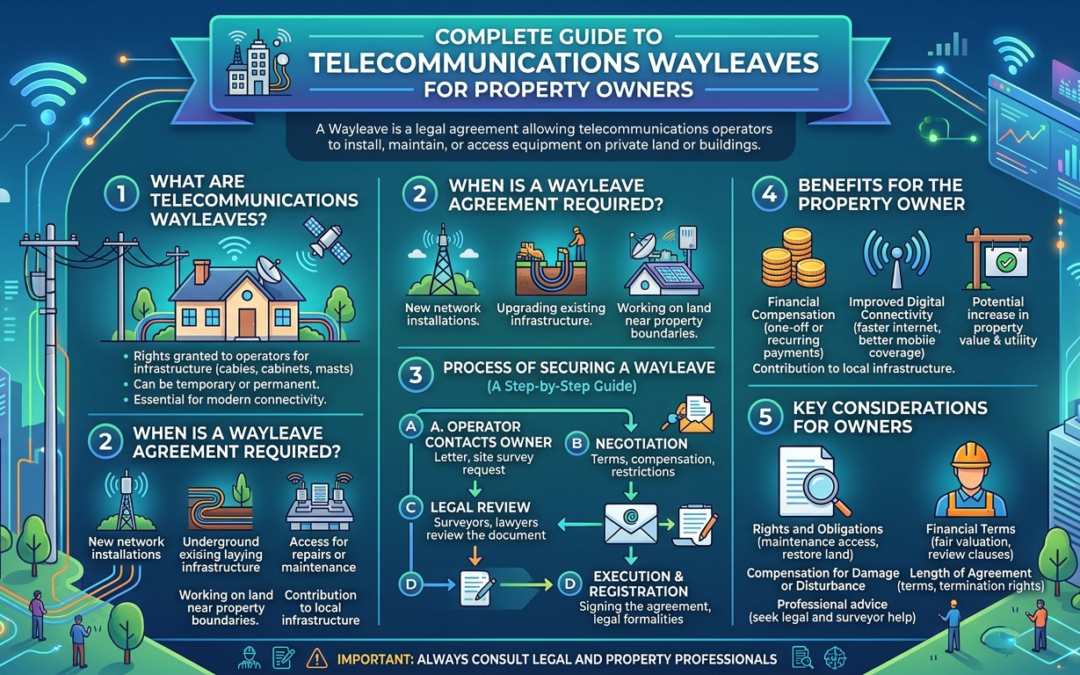
Wayleaves for Telecommunications: Complete Guide for Property Owners
Let’s say you need ultrafast broadband — 4K streaming of your favourite shows without buffering, working from home without lag, and video calling with zero awkwardness. And then… You hit your first bump: there is a wayleave that needs to be in place before any installation can happen.
For many in the UK, wayleaves are nothing but another piece of acronyms that should be complex or unconnected to their lives. But once you know what they are, why they matter, and how to deal with them confidently, they’re much less intimidating. By the end of this guide, you’ll be ready to handle the pitfalls and pain points around wayleaves — and know when you need reinforcements (cue specialists like ARC Partners ) Let’s break it down in plain British English — no faff, just useful insight.
What Is a Wayleave? A Simple Explanation
In layman’s terms, a wayleave is a type of legal agreement between you as the landowner and a telecoms company that gives the provider permission to access your land in order to install, operate, or maintain telecommunication apparatus — fibre-optic cables, etc. It’s not a sale, nor is it a lease: it’s a licence to use your land, for limited uses.
According to UK government guidance, wayleaves are most commonly used with fixed-line broadband infrastructure — as opposed to leases, which are generally applied to something such as a mobile mast.
You can charge for this right — it might be a one-off payment or an annual fee, depending on the circumstances and demand.
Key Advantages Of Wayleave To Telecom Companies
It’s fair, then, to wonder why we need wayleaves in the first place. After all, if a telecoms provider only needs to run an extra cable to your house or office, what’s the problem?
Here’s the deal — they can’t do anything without your permission. Without an agreed wayleave:
Providers cannot violate the law to access private land or property for installations.
Pending agreement, installations may be delayed or have been effectively blocked in whole.
This isn’t mere hypotheticals — real live infrastructure projects depend on wayleaves. CityFibre, for example, has secured wayleaves that enable it to pass through well over one million homes owned by local authorities and housing associations so that households can upgrade to full-fibre broadband without the need for each to gain individual permissions.
As demonstrated through data shared on London’s wayleave programme:
Even with these huge sums — partly because it’s impossible to install without wayleaves being signed first — 25–35% of London premises are still predicted not to have full-fibre connections by 2025.
Doing so effectively can remove legal and administrative bottlenecks in achieving wayleaves, accelerate the deployment of critical networks, and ultimately get more people online with next-generation broadband.’
Wayleave agreements usually contain the following:
Wayleave requests will typically be for:
- Planning where equipment will be deployed ongoing basis
- SELinux permissions ( like access and maintenance)
- Length of the agreement and any renewal options
- Compensation terms
Any conditions regarding health and safety, land being given back, etc.
When property owners and providers share better expectations terms, it is much easier for both parties to get the agreement in place when a simplified but standardised wayleave template — similar to those produced for the City of London — is used.
Wayleave vs Easement — What Is The Difference?
But you might hear the word easement thrown around in discussions of property law. That’ll be getting to both land rights, which involve:
Wayleave deals are normally temporary and can change, bestowing a supplier the right to place and obtain types of framework.
An easement reaches further — usually for long-lasting things like utility rights.
Wayleaves normally apply to telecoms infrastructure, enabling the terms to be stipulated clearly with the landowner and revised if necessary.
Common Misconceptions About Wayleaves
There are a few common misconceptions that emerge.
“I have to sign a wayleave — otherwise they can’t put anything up.”
True, you can walk away if you don’t like it, but sitting out generally means a longer wait — or the loss of opportunities for improved services. Certain legal frameworks (like statutory provisions in the Electronic Communications Code) grant telecoms providers rights to apply for access even when initial consent is not gained — but this approach tends to be a last resort.
“Wayleaves are just paperwork.”
Definitely not — these things are legal contracts. They protect your rights, create boundaries, and avoid conflicts later on.
Should You Get Professional Help?
The physical details of this process, negotiation and documentation — especially for commercial properties, agricultural land or multi-let premises — can be complex.
That’s where the experts at Arc Partners come in. They are also experts in wayleaves and telecoms infrastructure, which means they can:
- Review proposed agreements
- Negotiate fair compensation
- Manage correspondence with operators
- Ensure that they do not hurt you in the future
If you want to ease stress in the process or ensure you’re not leaving value on the table, partnering with professionals is often a good idea. Visit https://www.arcpartners.co.uk/ for tailored support.
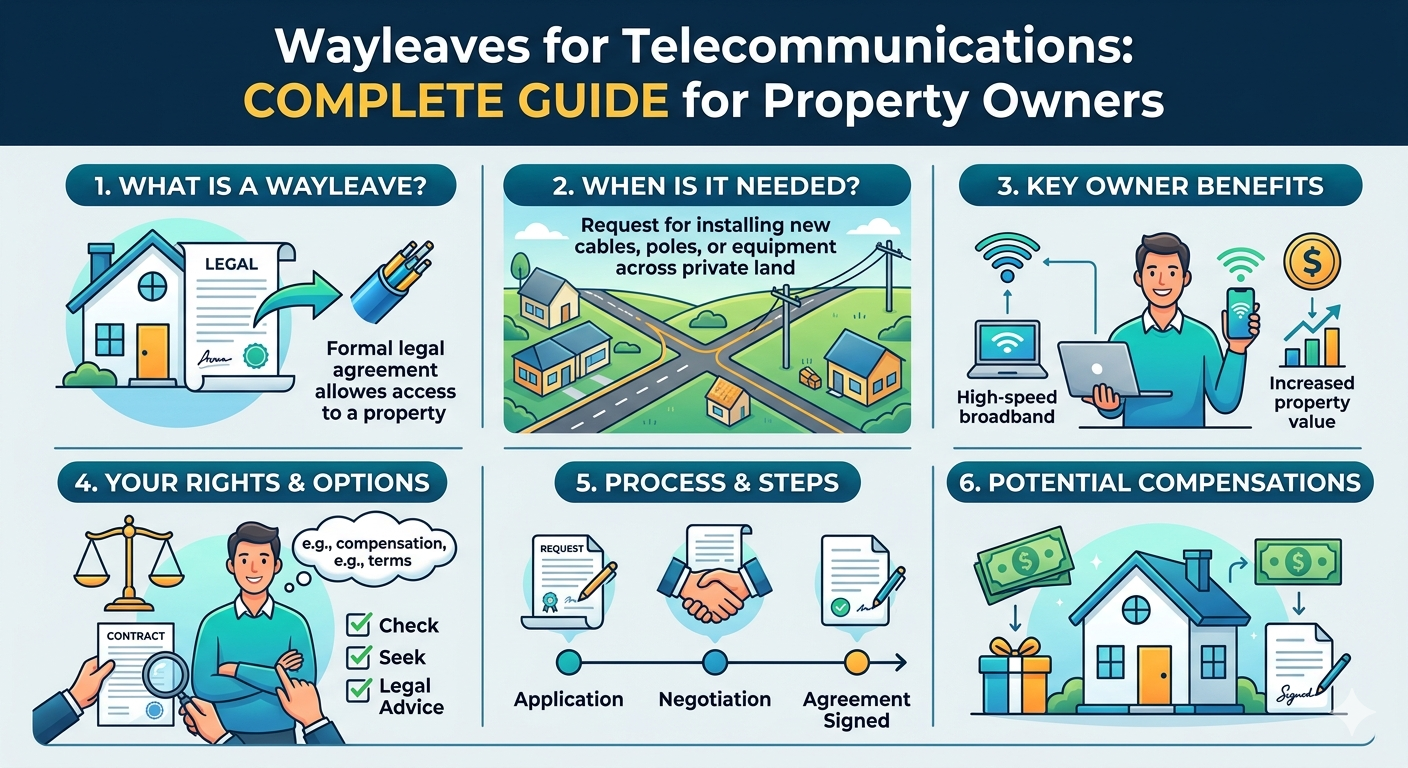
What Happens Next?
Once a wayleave is agreed:
- The installer schedules the installation
- They’ll schedule the work
- They’ll do the setup and testing
You will receive copies of all final contracts and documents
It is important to understand the process so you avoid surprises, and more importantly, your property is protected before, during, and after the install.
Frequently Asked Questions for Wayleaves for Telecommunications:
Ques. What exactly is a wayleave?
Ans. A wayleave is a form of legal permission made between the landowner and a telecoms provider that allows them to install, access, and maintain infrastructure on your land. It isn’t ownership — it’s permission within agreed terms.
Ques. Broadband wayleave for every property: Is it all about your broadband?
Ans. Not always. If the cable run doesn’t cross onto private land, or if there are existing rights in place, a wayleave may not be needed — but that will be confirmed by the provider.
Ques. Can I negotiate the compensation?
Ans. Yes — compensation, lump sum or periodic, is negotiable and should be commensurate with impact and rights granted.
Ques. How long do wayleaves last?
Ans. That depends on the terms. Some are indefinite, others have fixed terms that may be renewed.
Ques. Are wayleaves the same as easements?
Ans. No. A wayleave is a type of temporary licence; an easement, more like a permanent right.
Ques. What if I refuse to sign?
Ans. A refusal of a wayleave can hold up installation, too. Only in a much rarer case, and failing negotiation, can they be granted access by law.
Ques. Do tenants or landlords sign?
Ans. Wayleaves are typically signed by landlords or freeholders, although it may also be necessary for long-lease tenants to sign them, depending on the rights associated with the property.
Ques. Do I need a solicitor?
Ans. So, for basic household installs, probably not. Having the assistance of a professional in business or other complex circumstances can help protect your interests.
Ques. Can wayleaves improve property value?
Ans. Indirectly, yes. Homes with good broadband access are typically much more desirable to buyers or renters.
Ques. How is it possible to get standard forms?
Ans. Official guides are released by government and industry bodies for everything, from the City of London wayleave toolkit to standardised templates.
Wrapping Up!
A wayleave doesn’t need to be a headache. Once you know what it is and why it matters, and how to negotiate it, you’re in the driver’s seat. Whether you’re a residential homeowner, landlord, and farmers or a commercial property owner, managing wayleaves clearly ensures that you can still enjoy the convenience of modern connectivity — without the confusion.
If you prefer living your life or running your business, and leaving the legal and technical parts to others, professionals such as ARC Partners are just a mouse click away: https://www.arcpartners.co.uk/.