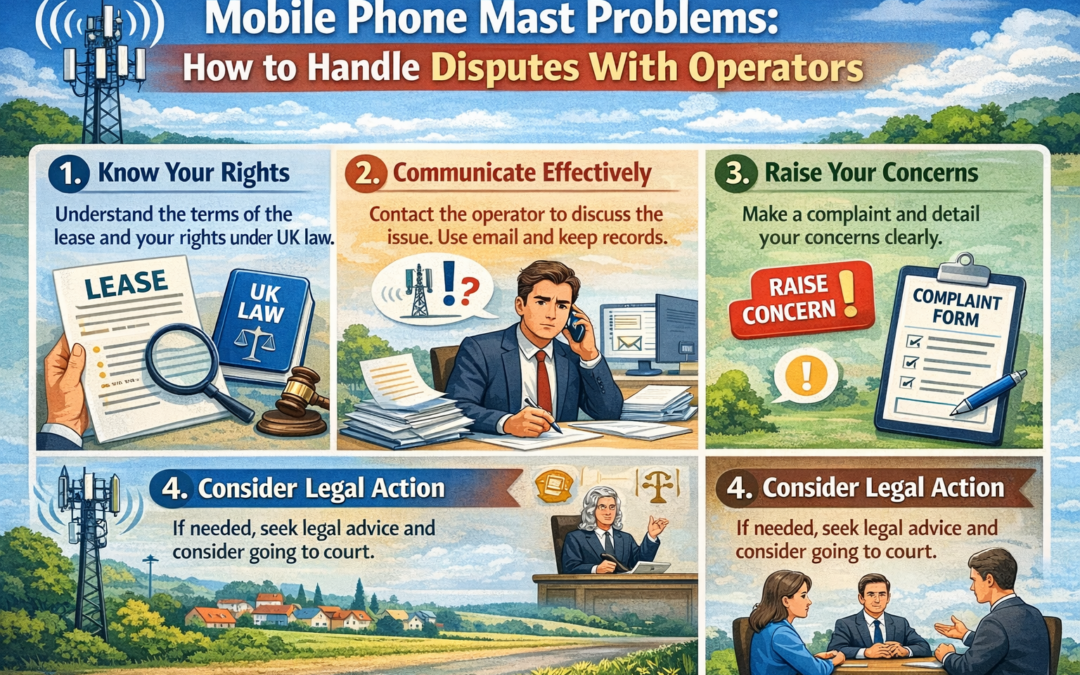
Masts for mobile phones are essential for enabling and maintaining communication in today’s society; however, they create a number of difficulties with respect to rights and financial aspects to land owners. If you, as a landowner, have been approached by telecom firms with propositions to put in place or maintain their telecommunications devices/lines on private property, you need to be aware of your legal rights concerning this activity and how to effectively resolve any potential disputes.
Since there is an increasing rollout of 4G and 5G networks in the UK, the volume of disputes between telecom firms and landowners is also increasing, largely due to the implementation of the Electronic Communications Code (ECC).
The purpose of this document is to describe situations where you may face difficulty with respect to a mobile phone mast and to provide a clear and practical strategy for resolving these disputed situations.
What Are Mobile Phone Mast Agreements?
Mobile Phone mast agreements are used to legally permit a telecom firm to install and maintain its telecommunications devices and lines upon privately owned property. Mobile phone mast agreements can be created through the use of lease or licence contracts and generally contain clauses related to access for installation, maintenance or upgrades.
Generally, landowners receive payments from the telecom firms as compensation for their use of land to provide a service (telecommunications); however, this form of compensation may vary greatly on the contract terms and conditions for the various telecom firms. Careful consideration needs to be given to the contract terms to better understand what obligations you will have to perform with respect to the proposed telecommunications equipment, as well as the rights you may have against the telecom firm for failing to properly perform under the contract terms. You should take the time to thoroughly review and understand the contract before agreeing to it.
Why There Are More Disputes Between Telecoms Operators and Landowners
In recent years, there has been an increase in disputes between telecom companies (telecom) due largely to the changes made in the Electronic Communications Code (ECC). While these changes aimed to favourably support the development of digital telecommunications infrastructure, they have also tilted the power toward telecom companies.
Several reasons for the rise in disputes include:
1) Decreased rent payments associated with newer agreements compared to previous agreements
2) Increased rights for telecoms to access land.
3) The restricted ability (of landowners) to deny telecoms access to install communications equipment.
4) The complex legal process associated with trying to escalate the situation.
Because of these changes, many landowners may feel pressured to accept unfavourable terms of agreement without a full understanding of their rights.
Common Mobile Phone Mast Problems That Landowners Face Associated with Cellular Communications Masts
By taking the time to understand some of the common issues landowners face, you can plan accordingly so that you can respond more effectively.
- Low Rent Offers
It is quite common for landowners to be upset about the significant difference in rent that they will receive under the new agreement, versus the rent they received under their older agreements. Most new masts are being offered at prices significantly below market prices.
- Forced Access to Land
Telecoms have the ability to apply to the tribunal if you refuse them the right to access your land. While this does not automatically mean that they can install equipment on your property, it does create some pressure on landowners.
- Restrictions on Your Use of Your Land
Agreements with telecoms may impact how you would like to use your property in the future. For example, you may not have the ability to redevelop your property in the future as a result of an agreement that you previously made with a telecom.
Having to remove a cell tower from your property isn’t very straightforward. In many cases, you will need to show that you genuinely intend to redevelop the property you have the equipment on, and even then, the process can be lengthy.
While telecommunication companies have gained a lot more power under the new regulations, you, as the landowner, still retain many rights. These include:
- The right to be informed and consulted before any satellite-based service is provided
- The right to negotiate the terms of the agreement with the telecommunication company
- The right to obtain professional advice
- The right to dispute unfair terms
Step-by-Step Guide: How to Handle a Mast Dispute
Telecommunications companies cannot just place equipment on your land without going through the legal process.
If you’re in a dispute with your telecommunication company, taking the right steps will greatly improve your position. Here’s a guide on how to proceed.
Step 1: Don’t Accept the Initial Offer Immediately
Many initial offers are designed to favour the telecommunications company. Before accepting an initial offer, review the terms in depth and do not feel pressured to agree.
Step 2: Review the Agreement in Detail
Review all key clauses of the agreement in detail such as:
- Rental payment amounts
- Length of time the agreement is valid for
- Rights to access your property
- Rights to upgrade the telecommunications equipment
It is important to understand the above clauses before making any final decisions on what to do with the telecommunication company.
When you work with legal experts and surveying professionals early on, you’ll have a better chance of discovering any risks and negotiating better terms for your agreement. Companies like ARC Partners focus on property law and telecommunication disputes and offer tailored advice for you to protect the rights of landowners.
Step 3: Obtain Professional Advice Early
Engaging legal and surveying experts at an early stage can help you identify risks and negotiate better terms. Firms such as Arc Partners specialise in property and telecoms disputes, offering tailored advice to protect landowner interests.
Stage 4 – Negotiate Terms From a Strategic Standpoint
Some examples of things that can be negotiated for include:
- Higher rates of rent
- Access to your property under better conditions
- Limitations on how the operator may upgrade the equipment that they use
A well-planned negotiation strategy can make a considerable difference in your negotiations.
Stage 5 – Go to Tribunal If Necessary
If you cannot come to an agreement with the operator, the matter may have to go to a tribunal. While this may seem overwhelming, having a legal professional represent you can help you achieve an outcome that you are satisfied with through the tribunal’s decision.

What If I Refuse to Allow the Telecoms Operator Access?
Refusing access to the operator is not the end of the process. Under the ECC, the operator has the ability to give you notice and apply to the tribunal for the right to install/make repairs to an installation.
The tribunal will take the following into consideration:
- The public benefit to having better connectivity in the area
- How my decision affects the landowners’ interests
- If an alternative site is available
The tribunal may grant the operator the rights that are requested; however, that does not mean that we cannot negotiate better terms from the beginning to the end of the proceeding.
Can You Decommission a Mobile Phone Tower?
It may be possible to remove a cell tower; in most instances, it can be problematic. You usually need to show an intention to redevelop the land with supporting proof, such as planning permission.
In addition, the process may potentially involve a legal battle and/or negotiations for compensation. For more advice on how to effectively manage this complicated area, seek expert help.
How Much Rent Should You Receive?
Under the ECC, there have been many changes in how rental values for telecommunication sites are determined. In comparison to the way the market used to determine value, your rent will be determined by its contribution to your telecommunications provider, even though this will usually result in a lower value.
However, you can still negotiate rent. The following may affect the rent being offered to you:
- The distance from the tower to your home.
- The demand for coverage in your area.
- The impact on your property.
Consulting a professional can help you ensure that you are receiving the maximum financial benefit.
What Common Mistakes do Landowners Make?
There are some common mistakes that, when identified and resolved, will create a more favourable negotiating position:
- Accepting the first offer without negotiating.
- Not obtaining legal advice;
- Ignoring long-term restrictive covenants, and
- Underestimating the rights of the telecommunications operator.
Being proactive and well-informed will help you avoid creating costly mistakes.
When to Engage the Services of a Specialist Telecoms Dispute Specialist.
Disputes with telecommunications operators have the potential to become complicated in a matter of seconds. You should consider enlisting the service of a specialist as soon as:
- A formal notice is given to the landowner by an operator.
- The negotiations break down.
- The landowner’s rights are then legally affected.
- The landowner wants to maximise the income generated from the rental of its land.
ARC Partners provides professional legal assistance to landowners with property and telecoms disputes, assisting the landowner through the negotiation process, protecting their rights and reaching a successful conclusion.
You can also explore How to Get a Mobile Phone Mast on Your Land: A Complete Guide for the Landowners in the UK.
Expert Tips to Increase Your Chances of Success
In order to improve your chances of success with your land:
- Contact an expert very early in the process.
- Understand your legal rights under the Electronic Communications Code (ECC).
- Document any effect on your land.
- Take time before you reach a decision.
Having as much information as possible on hand before you start negotiating will give you significant negotiating power.
Final Thoughts: Protecting Your Land Rights
Site sharing agreements for mobile phone masts can be complicated and, in some cases, difficult for landowners to negotiate. Although mobile telecoms operators play an important part in providing connectivity to customers, it is critical that your land rights are protected.
If you have a good understanding of the relevant law, use expert opinion and negotiate with care, you are likely to achieve a fair resolution and avoid any unnecessary disputes.
Frequently Asked Questions for Mobile Phone Mast Problems:
Can a telecoms operator force entry onto my land?
Telecoms operators cannot automatically gain access to your land but may apply to a tribunal for access under the Electronic Communications Code. If the tribunal considers that the wider public benefit of granting access to the land outweighs the effect of doing so on the landowner, it may grant the telecoms operator access to the relevant part of your land.
What is the usual rental amount for a mobile phone mast?
The rental payment will depend upon where you live, demand in your area and your agreement terms. Due to recent changes in legislation, it is likely that rents will be lower than they used to be; however, with suitable professional guidance, landowners can negotiate better conditions.
Is it possible to say no to a mobile phone mast on your land?
You can say no to the initial approach; the mobile phone operator may take you to court through a tribunal. So you can refuse the initial approach, but there is no guarantee that they won’t put their equipment there.
How will disputes between telecom operators be resolved?
Typically, they are resolved between the two parties or through a tribunal if necessary. Having legal guidance/ legal advice and properly preparing for negotiations are good ways for a landowner as they will get a better outcome from the negotiations and hopefully avoid putting the landowner into an unfavourable agreement.
Can I get an existing mobile phone mast taken away?
It is possible to remove an existing mobile phone mast; however, you will need very compelling reasons to do so, for example, if the land is to be redeveloped. The process to remove a mobile phone mast can be complicated and involve legal action; therefore, it is advisable to seek professional guidance.