
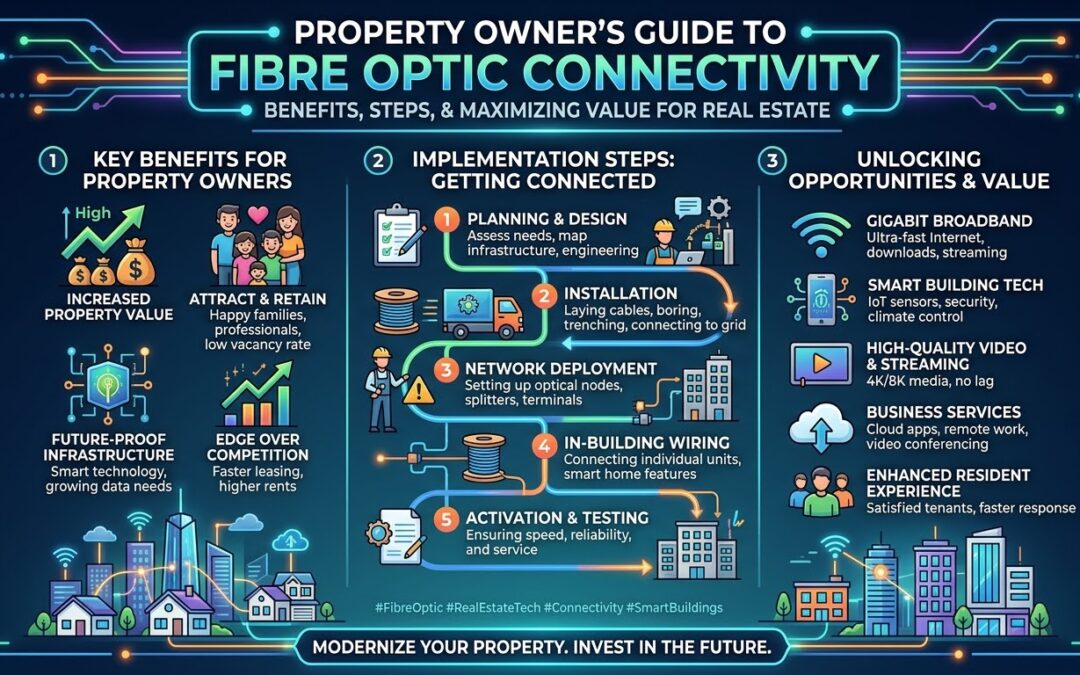
Fibre Optic Connectivity for Property Owners: Why It Matters More Than Ever
Property Owners Network Connectivity For Much More Than Ever
In the modern digital era, connectivity is not a luxury anymore; it has become an essential part of living and business operations. No matter if you are looking after residential flats, commercial buildings, or mixed-use developments, fibre optic connectivity is fast becoming one of (if not the most) valuable infrastructure upgrades a property owner can make.
Think of how people live and work today. Remote working, smart home technology, cloud applications, streaming services, and digital security systems all require stable high-speed internet. For tenants and businesses, slow or unreliable broadband can make or break a property choice.
This is where fibre optic broadband primarily comes into play. Fibre networks are turning buildings into future-ready digital environments that receive ultra-fast speeds, reliability, and scalability.
By working with knowledgeable infrastructure specialists like Arc Partners, property owners can enjoy a much smoother experience regarding the deployment of fibre connectivity. From planning to installing network infrastructure and coordinating the project, experts guide buildings in their readiness for the digital needs of today and tomorrow.
What Is Fibre Optic Connectivity?
The transmission of data through fibre optic connectivity is facilitated by means of thin strands of glass or plastic fibres that transmit data in the form of light pulses rather than electrical signals.
There are several advantages this technology has over traditional copper broadband:
- Much higher data capacity
- Faster upload and download speeds
- Lower latency
- Higher reliability and top resistance to noise
Full-fibre networks offer speeds of 1 Gbps or more, allowing video conferencing, seamless connectivity for 4K streams, and the use of cloud computing and smart building systems.
Property owners looking to provision fibre for multi-tenant buildings can also take the opportunity to deploy scalable infrastructure that is capable of servicing hundreds of users at a time.
Fibre vs Traditional Broadband
| Feature | Fibre Optic Broadband | Traditional Copper Broadband |
| Data Transmission | Uses light signals through fibre cables | Uses electrical signals |
| Typical Speed | Up to 1 Gbps or higher | 10–100 Mbps |
| Reliability | Very stable and resistant to interference | Can be affected by distance and signal loss |
| Latency | Very low latency | Higher latency |
| Future Scalability | Highly scalable for future technologies | Limited upgrade potential |
The Importance of Fibre Connectivity for Property Owners
Increased Property Value
The value of real estate is now heavily reliant on digital infrastructure.
Buildings that offer high-speed fibre broadband are generally more appealing to buyers, investors, and tenants. In a number of urban regions, reliable internet connectivity is seen at this point as a basic need — very much like power or water.
Consequently, fibre connectivity can be a major selling point for landlords and developers.
Higher Tenant Satisfaction
Tenants are now much more selective about the speeds of their home or workplace internet.
Frustration at slow broadband comes easily, particularly for:
- Remote workers
- Digital businesses
- Students
- Streaming and gaming users
For tenants to enjoy stable, high-speed internet access, to lower complaints, and improve tenant retention, installing fibre connectivity is an optimal solution.
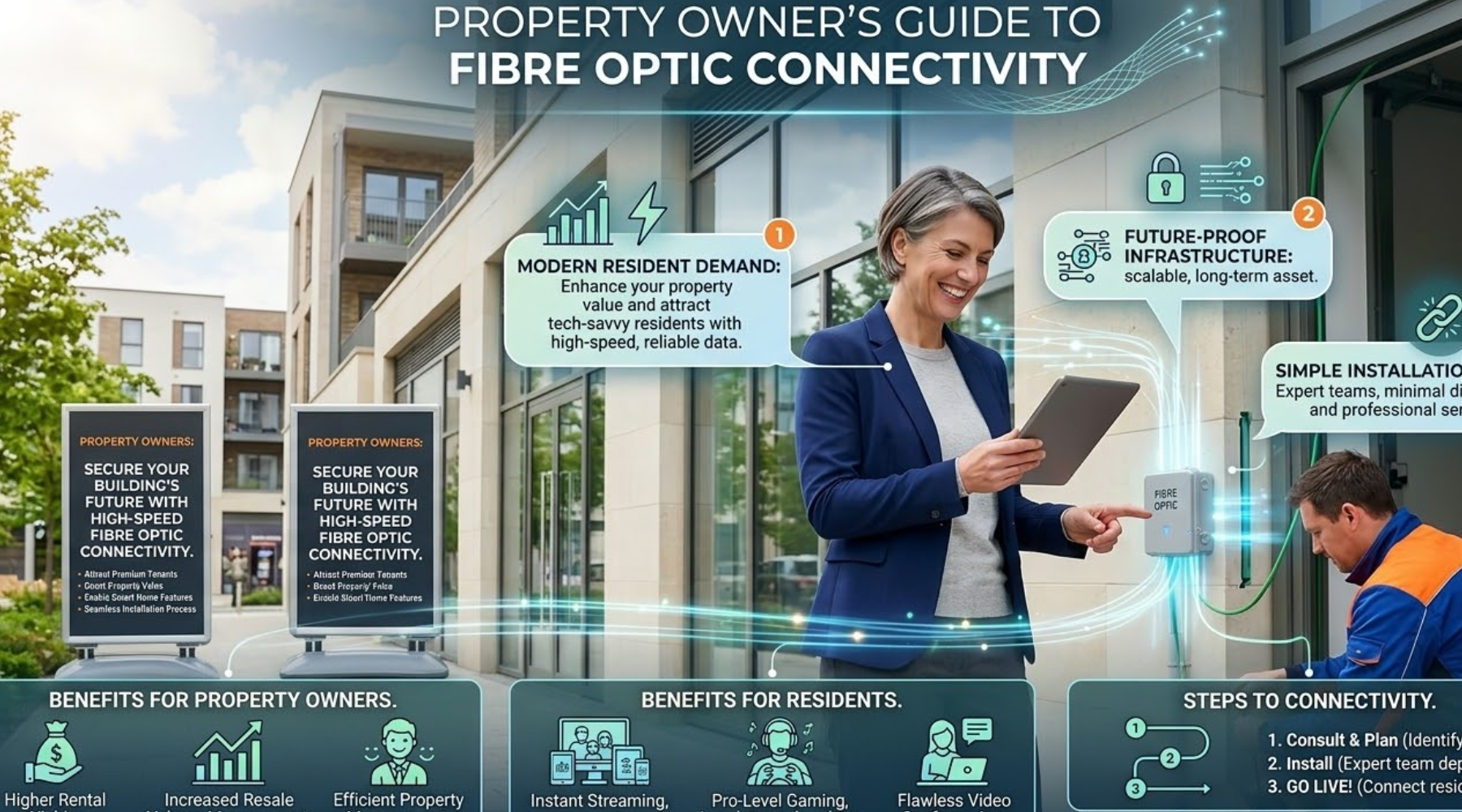
Future-Proof Infrastructure
Gradually transitioning from a phased-out copper networks up around the UK.
Fibre networks also offer the scalability to support future technologies as digital demand continues to rise, including:
- Smart building management systems
- Internet of Things (IoT) devices
- AI-based security systems
- Cloud-based services
Upgrading earlier allows property owners to avoid costly future retrofitting.
The Property Market Gives You a Competitive Edge
Modern residents want buildings that enable digital lifestyles.
Fibre infrastructure homes typically enjoy:
- Technology companies
- Co-working operators
- Digital start-ups
- Remote professionals
Studies suggest better broadband access can also boost local economic development, helping businesses grow. This positions fibre connectivity as a technical upgrade and a strategic investment.
Challenges Property Owners Often Face
It is worth noting, though, that in addition to its benefits, fibre connectivity can introduce many hurdles.
- Infrastructure Limitations
Older buildings might not have appropriate ducting or cable routes within.
- Multiple Stakeholders
Leaseholders, managing agents, and network providers may require separate approvals
- Installation Planning
Fibre Routes, access points, Equipment rooms, and Service Providers need to be factored into your network design.
- Technical Expertise
If not planned correctly, these installations can also be ineffective or unnecessary.
That is why many property owners choose to partner with experts like Arc Partners, who assist you in managing planning, infrastructure coordination, and deployment.
The role of fibre within smart buildings
Fibre connectivity is a building block of smart property technology.
There is a growing dependency on digital systems in most modern buildings for:
- Access control
- Security monitoring
- Energy management
- IoT devices
- Smart lighting and heating
Collectively, these technologies can rely on miles of fast and reliable data transmission — something fibre networks are uniquely positioned to support.
In a nutshell, strong connectivity is the foundation for smart buildings.
The Next Generation of Fibre Connectivity in the UK
The UK is now undergoing a very fast transition from copper broadband to full-fibre lines.
More than 20.7 million homes in the UK — nearly 69% of all properties — now have access to full-fibre broadband, according to Ofcom.
Additionally:
- Gigabit-capable broadband is available to around 84% of premises in the UK.
- Average broadband speeds in the UK are now well over 170 Mbps, and rising.
- The government’s Project Gigabit plans to make gigabit-capable connectivity available to 85% of the UK by 2025.
For property owners, this indicates that fibre connection will soon no longer be seen as an extra but a prerequisite.
Frequently Asked Questions (FAQs)
So why exactly should property owners consider investing in fibre optic connectivity?
That’s because fibre connectivity delivers faster and more reliable internet access for tenants, increasing the satisfaction of tenancies as well as property attractiveness. It also facilitates contemporary technologies like remote working, cloud services, and smart building systems.
Is fibre broadband better than what?
Yes. With a key difference being that instead of using electrical signals, fibre broadband uses light signals. This enables much faster speeds, lower latency, and better reliability relative to traditional copper broadband.
Does fibre connectivity add value to your property?
Yes. A sound digital infrastructure can make each property more attractive to its current tenants and potential buyers. Many renters now view dependable high-speed internet as an essential when deciding where to live or work.
How long does it take to install fibre in a building?
The amount of time for the installation will vary depending on the complexity or size of both the building and any existing infrastructure, as well as what networks are already available. For smaller buildings, this could take a couple of weeks; for larger developments, several months.
However, is fibre connectivity really that important for commercial buildings?
Absolutely. For cloud computing, video conferencing, and digital transactions, businesses depend on fast and reliable internet. Fibre guarantees Performance and Scalability.
Are Fibre Broadband Connections available for old Buildings?
Yes. Fibre connectivity can be retrofitted to most buildings, but for older buildings, this may necessitate additional in-building infrastructure works (i.e., internal cabling routes or duct installations).
What is gigabit broadband?
Gigabit broadband describes internet connections that can provide download rates of about 1 Gbps (gigabit per second). These speeds enable multiple users to stream, download, and work online at the same time without performance issues.
Why is fibre also instrumental in enabling smart building technology?
Real-time data transmission is essential for smart building systems. IoT devices, automated security systems, and energy-management platforms all need the high bandwidth and low latency that fibre networks provide.
How is fibre deployed by connectivity specialists?
Connectivity specialists are responsible for planning, designing the infrastructure, and coordinating installation. Working alongside property owners, contractors, and telecom providers to ensure that fibre networks can be installed quickly and efficiently.
Why do property developers choose to work with Arc Partners?
One company, for example, Arc Partners, facilitates property owners in the effective planning and delivery of their digital infrastructure projects. With their specialisation in connectivity strategy and infrastructure deployment, buildings can be provisioned with next-generation fibre networks, which ensure reliability.
Conclusion
Are Fibre Optic Connections Becoming a Property Essential? The buildings we visit are no different, and as digital services evolve, demand for ultra-fast, reliable access to internet services is an inevitable expectation that tenants and businesses take for granted.
For property owners, it is not just about internet speed when investing in fibre. It’s ensuring properties are future-proofed, enhancing tenant experience, and adding long-term value to the property.
By collaborating with experienced connectivity professionals like Arc Partners, building owners can navigate the DNA of fibre deployment and ensure their properties are competitive in the digital economy.